
Highlighting important regions with ISM#
In silico mutagenesis (ISM) mutates every position in a region to each alternative base and scores the predicted effect of each substitution, revealing which bases drive a model’s predictions. This tutorial uses ISM with AlphaGenome 2 to identify the bases that drive predicted DNase-seq accessibility across the central 256 bp of a 16 kb sequence window on chr20 in K562 cells (EFO:0002067). A 16 kb context keeps the 768 predictions fast; use dna_client.SEQUENCE_LENGTH_1MB (1 Mb) for highest accuracy, but at a slower speed.
Key activities:
Define a 16 kb context interval and a 256 bp target
ism_intervalScore all 768 single-base substitutions across
ism_intervalwithscore_ism_variantsVisualize per-base attribution scores as a sequence logo
Here is a visual overview of this process:
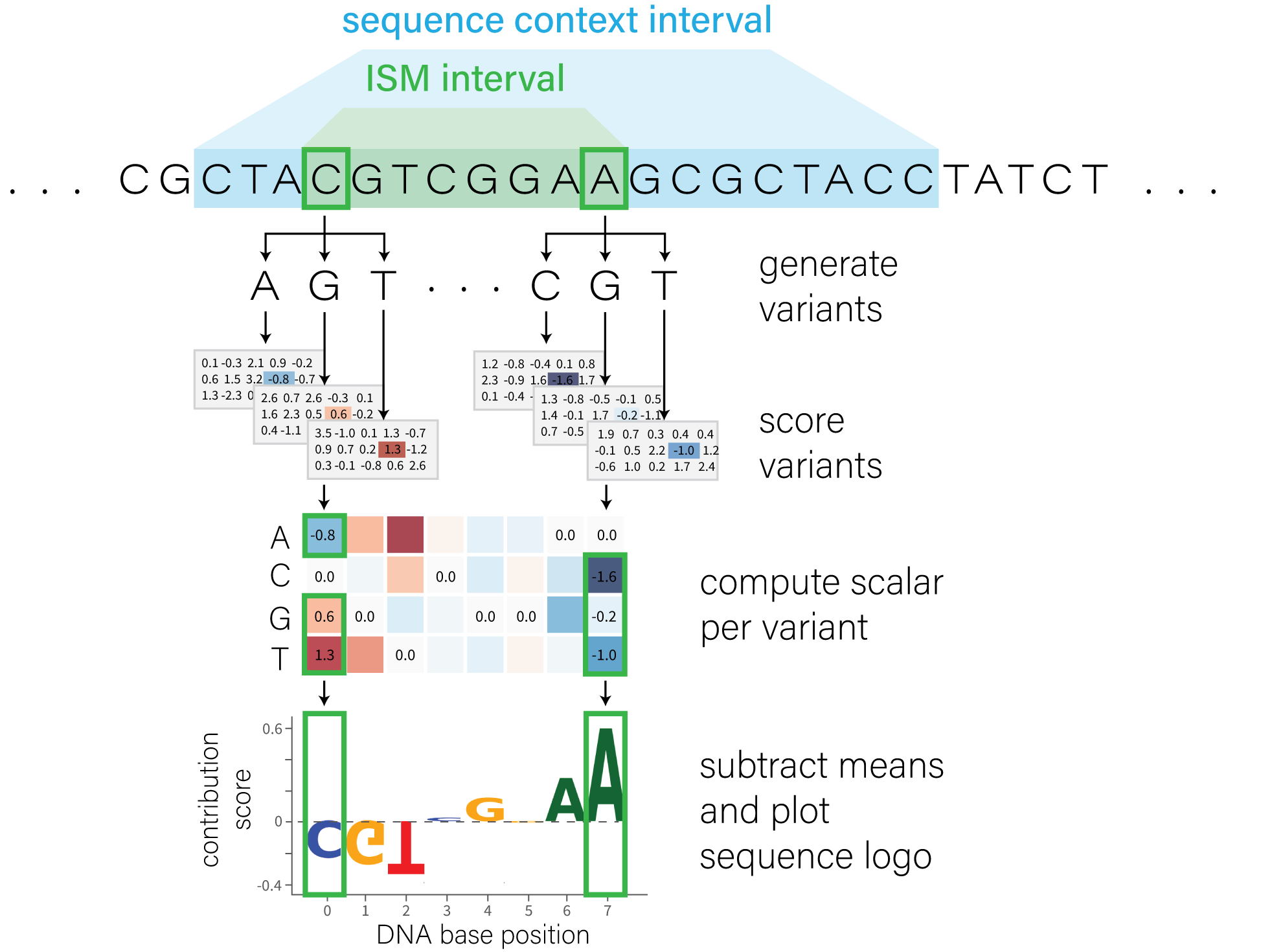
Set up#
# @title Install AlphaGenome

# @markdown Run this cell to install AlphaGenome.
from IPython.display import clear_output
! pip install alphagenome
clear_output()
# @title Imports
from alphagenome import colab_utils
from alphagenome.data import genome
from alphagenome.interpretation import ism
from alphagenome.models.v2 import dna_client
from alphagenome.models.v2 import variant_scorers
from alphagenome.visualization import plot_components
import matplotlib.pyplot as plt
Store your API key in Colab Secrets for persistent access across sessions (see Installation), then initialize the client:
dna_model = dna_client.create(colab_utils.get_api_key())
Define the context and ISM intervals#
We define an ism_interval, which is a relatively small region of DNA that we
want to systematically mutate. We also define the sequence_interval, which is
the contextual interval the model will use when making predictions for each
variant:
# 16 kb DNA sequence window used as context when making predictions.
sequence_interval = genome.Interval('chr20', 3_753_000, 3_753_400)
sequence_interval = sequence_interval.resize(dna_client.SEQUENCE_LENGTH_16KB)

# Mutate all bases in the central 256-base region of the sequence_interval.
ism_interval = sequence_interval.resize(256)
Choose a condition and scorer#
Search available reference conditions to retrieve the ontology CURIE for your target cell type or tissue. For more details, see Choosing a condition.
We examine DNase-seq accessibility predictions in K562 cells (EFO:0002067):
# Set condition
target_condition = 'EFO:0002067'  # K562
Next, we define a CenterMaskScorer that averages the ALT minus REF DNASE difference over a 501 bp window centered on each variant (DIFF_MEAN). variant_scorers.RECOMMENDED_VARIANT_SCORERS['DNASE'] uses the same 501 bp window with DIFF_LOG2_SUM and works here too; see How variant scoring works.
dnase_variant_scorer = variant_scorers.CenterMaskScorer(
    requested_output=dna_client.OutputType.DNASE,
    width=501,
    aggregation_type=variant_scorers.AggregationType.DIFF_MEAN,
)
Score all substitutions#
Call dna_model.score_ism_variants to score every single-base substitution in ism_interval (the client splits the window into 10 bp requests and evaluates them in parallel):
variant_scores = dna_model.score_ism_variants(
    interval=sequence_interval,
    ism_interval=ism_interval,
    variant_scorers=[dnase_variant_scorer],
    condition=target_condition,  # K562.
)
The length of the returned variant_scores is 768, since we scored 768 variants
(256 positions * 3 alternate bases per position):
len(variant_scores)
768
Each variant has scores of shape (1, 2), reflecting a non-gene-centric scorer across the 2 DNASE tracks for K562:
# Index into first variant and first scorer.
variant_scores[0][0].X.shape
(1, 2)
Select the paired-end track#
We have two tracks (for single-ended and paired-ended predictions). We select the paired-end track:
def extract_paired_end(adata):
  values = adata.X[
      :,
      (adata.var['endedness'] == 'paired'),
  ]
  assert values.size == 1
  return values.flatten()[0]


ism_result = ism.ism_matrix(
    [extract_paired_end(x[0]) for x in variant_scores],
    variants=[v[0].uns['variant'] for v in variant_scores],
)
ism.ism_matrix() defaults to multiply_by_sequence=True, so the output array retains non-zero contribution values only at the reference sequence base at each position.
The shape of ism_result is (256, 4) since we have 1 score per position for each of the 4 DNA bases:
ism_result.shape
(256, 4)
Plot a sequence logo#
To understand which positions most strongly influence predicted accessibility, we visualize the attribution matrix with plot_components.SeqLogo. Each variant was already reduced to a single scalar (the paired-end DNASE score) by extract_paired_end, and ism.ism_matrix arranged these values into a (position, base) matrix:
plot_components.plot(
    [
        plot_components.SeqLogo(
            scores=ism_result,
            scores_interval=ism_interval,
            ylabel='ISM K562 DNase',
        )
    ],
    interval=ism_interval,
    fig_width=35,
)

plt.show()

This plot shows that bases between positions ~225 and ~240 have the strongest effect on predicted nearby DNase-seq accessibility in K562 cells.
These contribution scores can be used to systematically discover motifs important for different modalities and cell types, identify candidate binding factors, and map motif instances across the genome. Common downstream motif tools include: